
 Odoo Consultation


 Odoo vs ERPS
 Odoo Apps
 ERP Implementation
 Odoo Customization
 Odoo Migration
 Odoo Hosting Services
 Odoo Success Packs
 Odoo Pricing
 Website Design
Introduction: Why Manufacturers Are Switching to Odoo
Manufacturing businesses today operate in a highly competitive environment where delays, inaccurate inventory, and disconnected systems can quickly reduce profitability. Many companies still rely on spreadsheets or outdated software, which leads to inefficiencies across production, procurement, and delivery.
This is where Odoo ERP is making a significant impact. As an all-in-one business management platform, Odoo helps manufacturers streamline operations, improve visibility, and scale efficiently.
In this blog, we explore real-world case studies from the manufacturing industry to understand how Odoo solves critical operational challenges and delivers measurable results.
What Makes Odoo Ideal for Manufacturing
Odoo ERP integrates key manufacturing functions into a single platform. Instead of managing multiple disconnected tools, businesses can handle everything from production planning to inventory and accounting in one system.
Key capabilities include:
- Real-time inventory tracking
- Automated production planning (MRP)
- Quality control management
- Procurement and supply chain integration
- Centralized reporting and analytics
This level of integration enables manufacturers to make faster decisions and reduce manual errors, ultimately improving productivity and cost efficiency.
Case Study 1: KTI Plastics – Improving Production Visibility
The Challenge
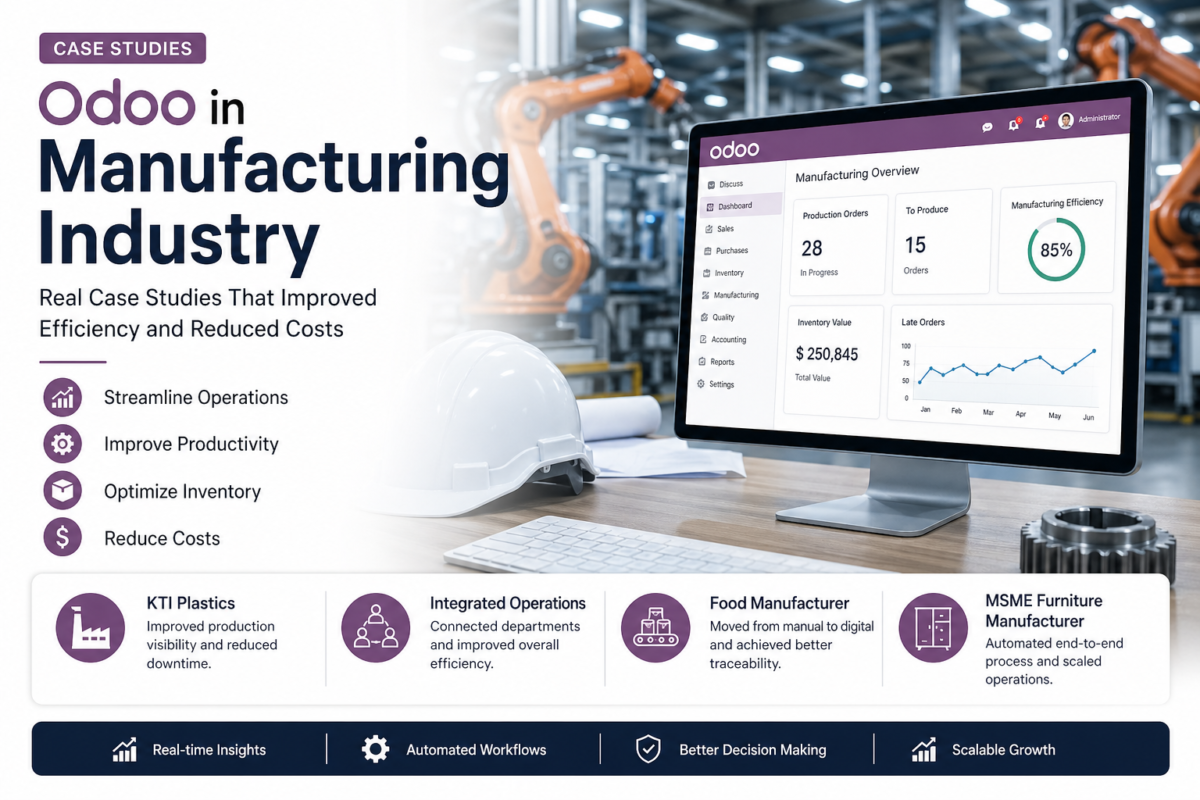
KTI Plastics faced operational challenges due to complex production workflows and limited visibility into inventory. The lack of real-time data resulted in stock shortages, production delays, and inconsistent product quality.
The Solution
The company implemented Odoo’s Manufacturing, Inventory, and Quality modules. These tools enabled automated production scheduling, real-time inventory tracking, and standardized quality checks.
The Outcome
With Odoo in place, KTI Plastics gained better control over its operations. Production cycles became faster, downtime was reduced, and product quality improved. The availability of real-time data allowed management to make more informed decisions and scale operations efficiently.
Case Study 2: Integrated Manufacturing Operations
The Challenge
Many manufacturing companies struggle with disconnected systems where departments such as procurement, production, and sales operate independently. This lack of integration leads to delays, miscommunication, and increased operational costs.
The Solution
Odoo provided a unified platform that connected all departments. By integrating procurement, inventory, production, and sales, businesses were able to create a seamless workflow across the organization.
The Outcome
The implementation resulted in improved coordination between departments, reduced operational costs, and faster decision-making. Companies experienced better demand forecasting and smoother production planning, which directly contributed to higher efficiency.
Case Study 3: Food Manufacturing Company – From Manual to Digital
The Challenge
A food manufacturing company relied heavily on spreadsheets and paper-based processes. This created issues such as data inaccuracies, slow order processing, and lack of traceability.
The Solution
By adopting Odoo, the company integrated accounting, inventory, order management, and distribution into a single system. This eliminated the need for manual data entry and reduced dependency on disconnected tools.
The Outcome
The transition to Odoo significantly improved operational efficiency. The company achieved better traceability of products, faster order processing, and more accurate financial reporting. This digital transformation also enhanced compliance with industry standards.
Case Study 4: MSME Furniture Manufacturer – End-to-End Automation
The Challenge
A small furniture manufacturing business managed its operations manually, including order processing, inventory tracking, and sales management. This resulted in inefficiencies and limited scalability.
The Solution
The business implemented Odoo modules for Manufacturing, Inventory, Sales, and Accounting. This created a fully integrated system that automated key business processes.
The Outcome
The company experienced faster transactions, improved inventory accuracy, and better overall efficiency. The integrated system enabled seamless coordination from order placement to final delivery, allowing the business to scale its operations with confidence.
Key Benefits of Odoo for Manufacturing Businesses
Across all these case studies, several consistent benefits of Odoo emerge:
- Improved operational visibility
Real-time data allows businesses to monitor production and inventory at every stage. - Enhanced efficiency
Automation reduces manual work and minimizes errors. - Better inventory management
Accurate stock tracking prevents shortages and overstocking. - Cost reduction
Streamlined processes and better planning lower operational costs. - Scalability
Odoo supports business growth by adapting to increasing operational complexity.
These advantages make Odoo a reliable solution for both small manufacturers and large enterprises.
How Odoo Drives Higher ROI in Manufacturing
Implementing Odoo is not just about digitization; it is about achieving measurable business outcomes. Manufacturers using Odoo often report increased productivity, reduced waste, and improved customer satisfaction.
By centralizing operations, Odoo eliminates inefficiencies and enables better resource utilization. This leads to higher return on investment and long-term business growth.
Conclusion: Is Odoo the Right Choice for Your Manufacturing Business
The manufacturing industry is rapidly evolving, and businesses that fail to adopt modern solutions risk falling behind. The case studies discussed above demonstrate how Odoo helps companies overcome operational challenges and achieve sustainable growth.
Whether it is improving production planning, enhancing inventory accuracy, or integrating multiple business functions, Odoo provides a comprehensive solution tailored to manufacturing needs.
For businesses looking to streamline operations and improve efficiency, Odoo is a practical and scalable choice.
Frequently Asked Questions (FAQs)
What is Odoo ERP used for in manufacturing
Odoo ERP is used to manage manufacturing processes such as production planning, inventory control, procurement, and quality management within a single integrated system.
Is Odoo suitable for small manufacturing businesses
Yes, Odoo is highly scalable and can be customized for small, medium, and large manufacturing businesses. It is especially useful for MSMEs looking to digitize operations.
How does Odoo improve inventory management
Odoo provides real-time inventory tracking, automated stock updates, and demand forecasting, which help prevent stock shortages and overstocking.
Can Odoo integrate with existing systems
Yes, Odoo can be integrated with various third-party tools and legacy systems, making it flexible for businesses transitioning from older software.
What are the main benefits of using Odoo in manufacturing
The main benefits include improved efficiency, reduced operational costs, better decision-making, and enhanced visibility across all business processes.
 Odoo Consultation
 Odoo vs ERPS
 Odoo Apps
 ERP Implementation
 Odoo Customization
 Odoo Migration
 Odoo Hosting Services
 Odoo Success Packs
 Odoo Pricing
 Real Estate
 Solar Energy
 Retail
 Cannabis
 Transportation & Logistics
 Maintenance Companies
 Energy & Utilities
 Ecommerce
 Construction
 Dental Offices
 Chemical Industry
 Odoo Restaurant